Can foreigners visit Xinjiang?
Yes. Foreign visitors can travel independently in Xinjiang, including cities such as Urumqi, Turpan and Kashgar. There is no region-wide Xinjiang travel permit; extra permissions apply to designated border areas and places not open to foreigners.
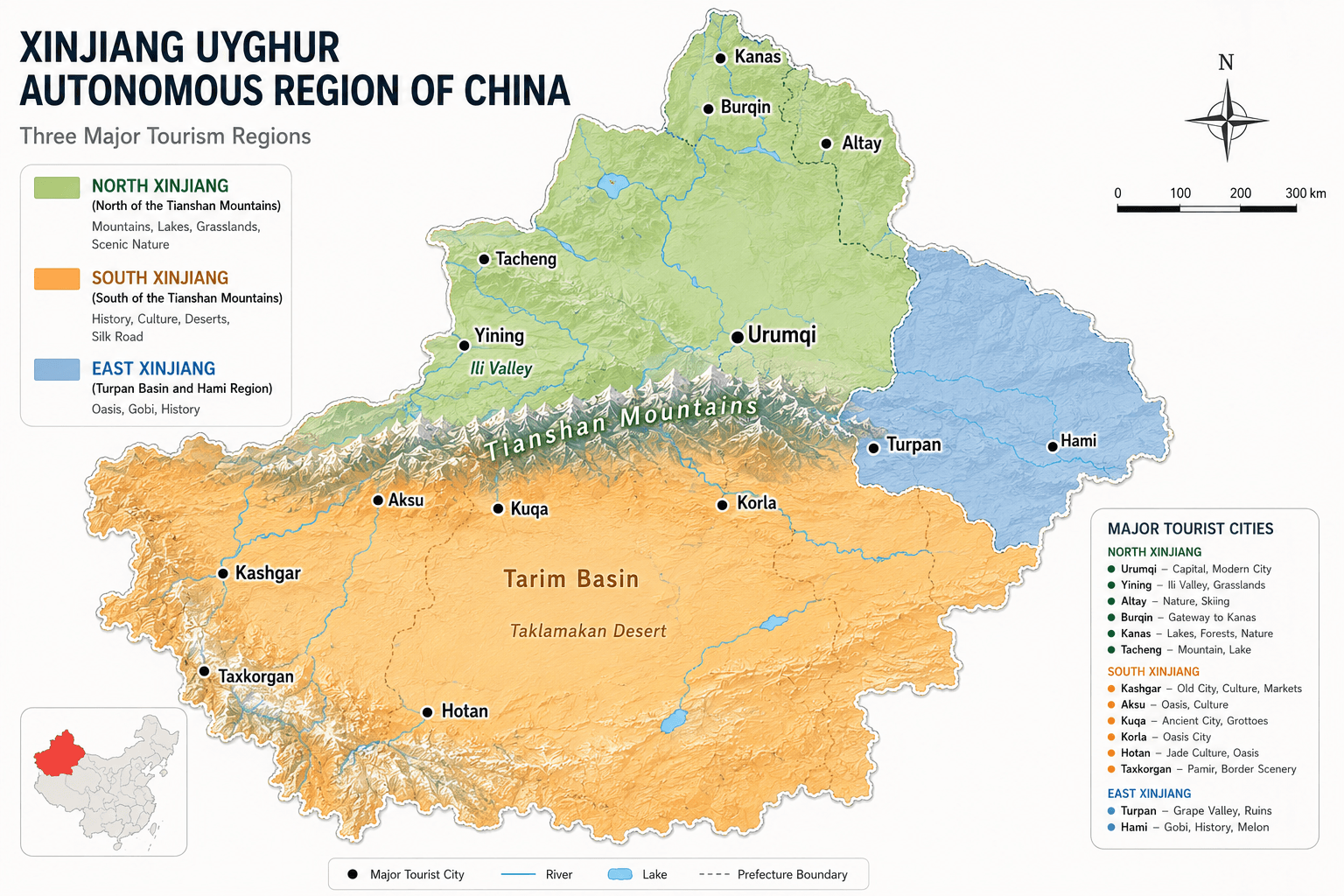
A few days in Kashgar might revolve around tea, bread and the old city's bazaars. Around Kanas, the draw is forest and lake; in Yili, it is grassland stretching towards the Tian Shan. Choosing which of these landscapes you want to spend time in gives a trip its shape.
North or south? Start with the places that draw you
The Tian Shan mountains divide Xinjiang into north and south. Even the north contains two distinct trips: Kanas and Hemu in the Altay region, and the Yili valley farther southwest. Linking them means a substantial journey between the two. For a week, we would choose one of the three routes below and give it room.

Kashgar: bazaars, tea houses and time to wander
Kashgar rewards a slower stay. The old city's lanes bring together naan bakeries, pottery shops and tea houses, with Uyghur craft traditions woven into its busy visitor streets. Leave space for an afternoon over tea as well as the sights.
For a city-based trip, pair Kashgar with Urumqi and Turpan. Urumqi and Turpan connect by rail; reaching Kashgar is a separate long-distance leg, with sleeper trains offering a way to travel overnight. With more time, Kuqa makes a stop along the southern rail corridor. Tashkurgan and the Pamir mountains are a different extension, with border-area formalities covered below.
Kanas and Hemu: lakes, birch forest and wooden villages
Kanas and Hemu belong together geographically. Lake walks at Kanas and a stay among Hemu's timber houses give this part of the north its appeal. Summer brings green valleys; September draws visitors for the turning birch and larch forests. Winter offers a snow-covered version of the same landscape, with a different set of road conditions.
We would build a week around this area, allowing for the journey in and out. A train or flight to the Altay region is only part of the trip: the villages and lakes still require road transfers. Adding Yili turns this into a longer journey with more travel days.
Yili and Sayram Lake: a summer grassland trip
Yili, also written Ili, is the choice for broad meadows and mountain scenery. Sayram Lake sits beside the route into the valley, while Nalati and Kalajun offer grasslands farther inside it. Late spring and summer suit this trip; June and July are particularly appealing for flowers and green pastures.
Use Yining as the city anchor, then build a road trip around Sayram Lake and a few grassland stops. For roughly a week, our suggestion is to choose Nalati or Kalajun and spend longer there. A summer journey can continue towards Kuqa via the Duku Highway, whose seasonal opening matters more than a neat line on the map.
Tashkurgan and the border areas
The journey towards Tashkurgan takes you into the Pamir border region. For sightseeing inside a designated border management area, Xinjiang's rules require foreign visitors to carry their passport and a border-area permit. This is separate from permission to enter China. Xinjiang border rules.
The permit is free. Although it is now electronic, foreign passport holders must apply in person at an exit-entry administration office or a designated police station. The online application described in many Chinese travel guides is for mainland Chinese residents. NIA application guide.
For a Pamir excursion from Kashgar, take the actual stops to the local exit-entry office when arranging the permit. Access to Tashkurgan does not establish access to every nearby valley or frontier viewpoint. A place not open to foreigners has a separate foreigner travel permit process; the border-area permit alone does not authorize that visit.
If you are crossing into or out of China through a land port, that is a separate case: Xinjiang's rules allow passage through the border area using valid entry or exit documents. The port must accept your crossing, and a sightseeing detour away from the crossing route falls under the travel rules above.
Getting around, with room for the journey
Trains work well for a route built around cities. Once the trip centres on lakes, villages and grasslands, road travel becomes a larger part of it. You can combine rail journeys with a driver for a particular stretch; hiring one does not mean joining a tour for the whole trip.
For most visitors, renting a car to drive themselves means obtaining a Chinese temporary driving permit. A foreign licence alone is generally insufficient; licence recognition agreements create exceptions for some holders. The application normally involves your passport, foreign licence, its Chinese translation and photographs. Official visitor guide (car rental section).
Duku Highway: make the mountain crossing part of the trip
The Duku Highway runs between Dushanzi and Kuqa across the Tian Shan, passing grasslands, high mountain scenery and canyons. It can connect a northern road trip with southern Xinjiang, but snow closes it for much of the year. Summer is the usual window; the opening and closing dates vary with conditions.
Build this stretch around time on the road and stops along the way. Access also depends on the section and vehicle: published controls include daytime travel windows and limits on larger passenger vehicles. The Xinjiang transport department's road notice explains the restrictions for the 2026 reopening. Use the current road status when fixing this part of your itinerary.
Sources and editorial notes
Checked on September 6, 2026. Route combinations and suggested time allowances are editorial recommendations, not fixed tour schedules.
- Kashgar government: international visitors and independent travel; Kashgar Old City's craft and bazaar streets.
- Xinjiang tourism department: landscapes and seasons; Yili government: summer destinations; Kanas and Hemu in autumn.
- Xinjiang's rail connections. No historic departure times or fares are used here.
- Kashgar police's June 2025 permit-office notice distinguishes foreign applicants from Chinese residents. Use the newer NIA guide for the electronic permit process. Neither notice provides a current list of every Pamir stop open to foreign visitors.
Last updated: September 6, 2026