Tibet Travel Permit: Where You Need One—and Where You Don’t
For tourists travelling on foreign passports, a Tibet Travel Permit is required to visit the Tibet Autonomous Region (TAR), including Lhasa. The requirement does not extend to every Tibetan cultural area in China. Chinese consular guidance.
Tibetan journeys through Amdo and Kham
A Tibetan journey can revolve around Labrang's monastery town, the painters of Repkong or Tagong's grasslands. These places belong to Amdo and Kham, two cultural regions stretching across today's provincial boundaries. You can explore the places below without entering the Tibet Autonomous Region or needing a Tibet Travel Permit.
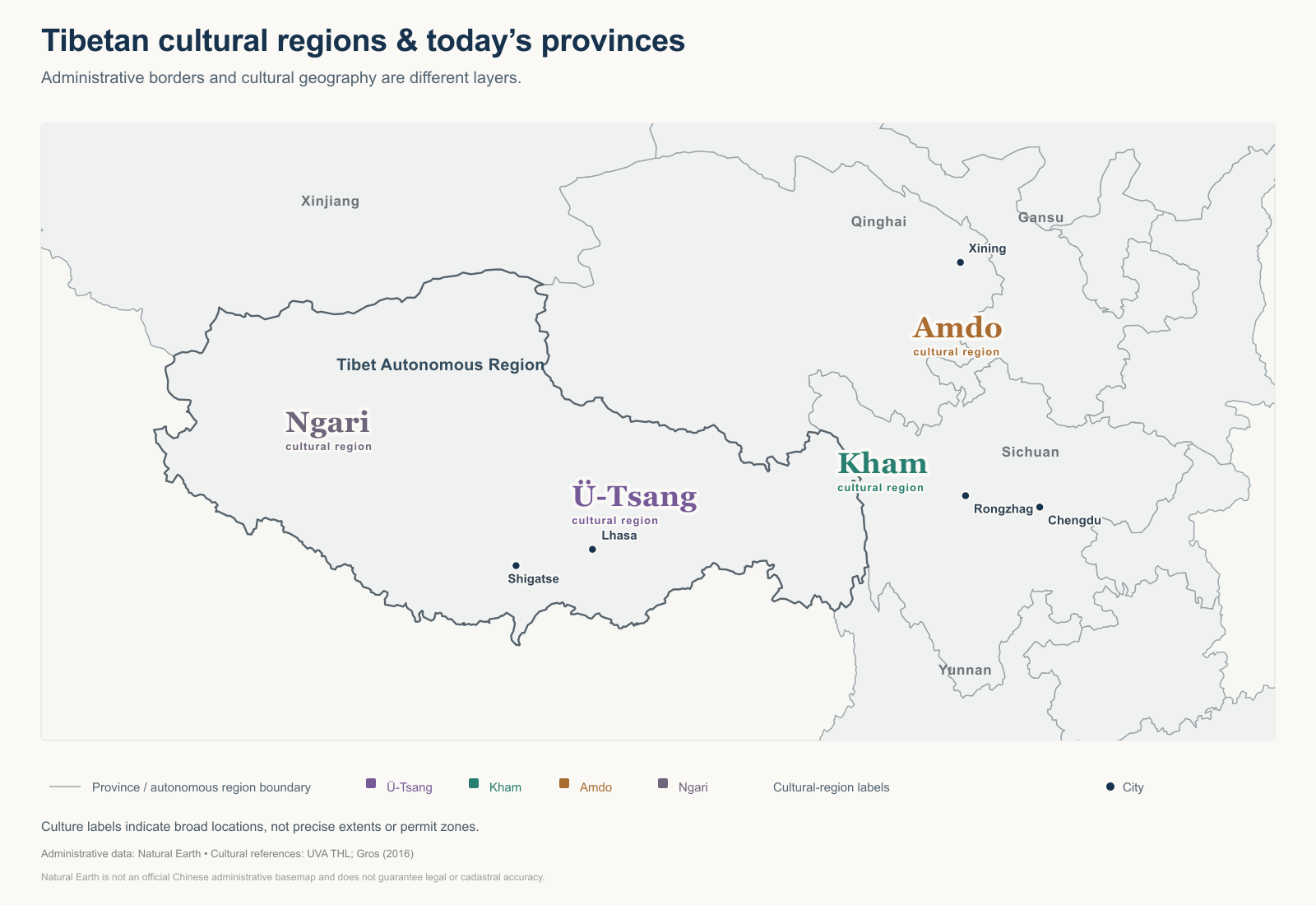
Amdo — monastery towns and art villages
Begin in Xiahe, where Labrang's monastic colleges make it one of the great centres of Tibetan Buddhist learning. Give the monastery time, then continue towards Langmusi and the surrounding grasslands. Our Xiahe and Langmusi guide covers this journey.
Repkong, also called Tongren, gives a journey an artistic focus. Its monasteries and villages are home to the Regong tradition of thangka painting, murals and sculpture, passed between generations of Tibetan and Tu artists. Start from Xining and explore Repkong and its art villages.
Kham — grassland monasteries and mountain towns
Around Kangding and Tagong, Tibetan monasteries sit among grasslands and mountain scenery. Tagong's monastery belongs to the Sakya tradition. A journey through Kangding and Tagong can begin in Chengdu, allowing time for the mountain roads.
Farther south, Songzanlin's halls, murals and thangkas give a stay in Shangri-La its cultural focus. Leave room for the old-town lanes of Dukezong as well. The railway from Lijiang makes Shangri-La a natural continuation of a Yunnan journey.
Where the permit applies
| Destinations | Province or region | Tibet Travel Permit? |
|---|---|---|
| Lhasa, Shigatse, Mount Kailash, Mount Everest (Tibet side) | Tibet Autonomous Region | Yes |
| Xiahe / Labrang, Langmusi, Zhagana | Gannan in Gansu; Langmusi straddles Gansu and Sichuan | No |
| Xining, Tongren / Repkong, Yushu, Golog | Qinghai | No |
| Kangding, Tagong, Danba, Litang, Daocheng Yading, Ruoergai | Garze and Aba in Sichuan | No |
| Shangri-La, Deqin, Meili Snow Mountain, Yubeng | Deqen / Diqing in Yunnan | No |
Entry into a designated foreigner-restricted area requires separate approval, including outside the TAR. China's Exit and Entry Administration Law, Article 44.
For example, staying in Xining or visiting Tongren does not require a Tibet Travel Permit. Continuing from Xining to Lhasa does—the destination is now inside the TAR.
Travelling in the TAR
Arrange your TAR trip through a qualified travel agency. The agency handles the Tibet Travel Permit application for foreign tourists and organises the itinerary. Share the places you want to visit so it can check which extra permissions your route needs. Shannan tourism bureau.
A Chinese visa—or visa-free entry to China—does not replace the Tibet Travel Permit. If you are using visa-free transit, the policy's permitted travel areas also limit your itinerary, even for destinations that do not require a Tibet Travel Permit. See the visa-free entry and transit guide and NIA transit rules.
Border-area permits
A border-area permit is a different document, for designated areas along China's international land border. Crossing between Gansu and Sichuan at Langmusi is a provincial crossing, not an international-border crossing; it does not itself trigger this requirement. See the NIA border-area guide.
If your itinerary requires an electronic border-area permit, foreign applicants must apply in person at a public-security exit/entry office or designated police station. The online application channel is for eligible mainland Chinese residents. See the NIA application guide.
Detailed sources
Permit guidance and cultural references checked on 17 November 2026.
- Gansu Tianditu on Labrang and the Gannan grasslands
- China Intangible Cultural Heritage on Regong arts
- Kangding government on Tagong and its Sakya monastery
- Diqing Intangible Cultural Heritage Centre on Songzanlin
- National Railway Administration on the Lijiang–Shangri-La railway
- Chinese consular guidance on travel to the TAR
- NIA, Exit and Entry Administration Law, Article 44
- UK government travel guidance for China regional risks
- Ruoergai County government description of Langmusi
- Yunnan Department of Natural Resources administrative source for Diqing
- NIA transit rules
- NIA electronic border-area permit application guide
- Shannan tourism bureau on Tibet Travel Permits and border formalities
Last updated: November 17, 2026